Chittorgarh:
Places to See
THE
FORT
A standing sentinel to the courage and valor of Chittaurgarh, it stands tall
over a 180 meter high hillock covering a massive area of 700 acres. The fort
is belileved to have been built by the Maurya rulers in 7th century AD.
Click here for details about Chittorgarh Fort
The important monuments inside the fort are:
VIJAY STAMBH OR 'VICTORY TOWER'
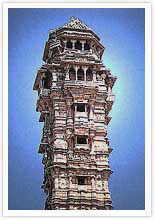
Built by Rana Kumbha in 1440 , to commemorate the victory over the combined
forces of the kings of neighboring Malwa and Gujarat, this tower is 120ft.
(36.5mts) high and has a girth of 30 ft. at the base, the nine storied high
limestone structure is richly ornamented from top to bottom.
KIRTI STAMBH OR 'TOWER OF FAME'
Built iln the 12th century, dedicated to Lord Sri Adinath Rishab deo, the
first Jain Tirthankar. The 22 metre high structure ils rdeplete with figures
from Jain pantheon. There are several other Jain temples iln Chittaurgarh.
RANA KUMBHA'S PALACE
The largest monument of the fort, it is believed that Rani Padmini committed
Jauhar, in once of these underground cellars. The palace is in ruins but generates
historical as well as architectural interest. The original palace was believed
to have been built by Rana Hamir after regaining the fort in the first siege.
The Mewar power reached its acme during Rana Kumbha's time, he was a great
patron of art and architecture, which is amply reflected in the palace.
PADMINI PALACE
The palace of Rani Padmini who preferred death before dishonor, and committed
Johar, along with her entire entourage before falling into the hands of Allauddin
Khilji. It was here that Rana Ratan Singh allowed a glimpse of the legendary
beauty to Allauddin Khilji. The Zanana Mahal overlooks the pond, Padmini stood
over here and the reflection of her was shown in the water to Allauddin Khilji.
MEERA TEMPLE
The temple is dedicated to the mystic poetess Meera, and a devotee of Lord
Krishna. Meera was born in Kurki village near Merta to Ratan Singh Rathors,
and was married to Bhojraj son of Rana Sanga of Mewar. Legends say that she
consumed poison set by Vikramaditya but nothing happended to her due to the
blessings of Lord Krishna. In front of the temple is the cenotaph (chhatri)
of Meera Bai's Guru Shri Rai Das of Banaras, inside the cenotaph is carved
a figure of five human bodies with one head, depicting that all castes are
equal and even outcasts can attain God.
KUMBHA SHYAM TEMPLE
The temple dedicated to Varah (Boar), the incarnation of Lord Vishnu. It was
built in 1448 AD. By Rana Kumbha Mahasati cenotaphs The cremation site of
the Ranas and their wives, the sites are marked with Chhatris.
KALIKA MATA TEMPLE
The temple is dedicated to Goddess Kali, the symbol of power and valour. Situated
towards the southern side of the fort, it was built by Rana Hamir. Originally
it was built as a Sun Temple by Bappa Rawal in the 8th century, but ws destroyed
during the first sack of Chittaur. Rana Hamir converted it into a Kali temple
on regaining the fort in the 14th century. The house of Chunda is situated
near the temple. There are several other temples, within the ramparts of the
fort like that of the temple of Annapurana, Jain Temples etc.
JAIMAL AND PATTA'S PALACE
The ruins of this palace remind once of the story of the gallant Rathores
Jaimal and Sisodia Patta the two great warriors, who layed down their lives
for the honour of Chittaurgarh.
GOVERNMENT MUSEUM
The magnificent Fateh Prakash Mahal has been converted into a museum, which
houses a rare and rich collectino of sculptures from the fort and the temples.
(Friday Closed)
GAUMUKH(COW'S MOUTH RESERVOIR)
Situated near the Mahasati Chowk, the water from a spring flows through a
stone structure carved in the form of a cow's mouth into the reservoir.
MOHAR MAGRI (HILL OF GOLD COINS)
A small structure which was raised during the invasion of Chittaurgarh by
Akbar in 1567, it gets the name Mohar Magri because it is believed that Emperor
Akbar paid one mohar (gold coin) for each basketful of earth placed on the
mound, as the work was very dangerous, brave soldiers guarding the the ramparts
fromabvoe. The mound was raised to such a height that the Mughal cannons could
be placed over it and fired inside the fort. The important places inside are,
the temple of Tulja Bhawani (the tutelary goddess of the scribes), the Naulakha
Bhandar or nine lakh treasury, Singar Chauri, depicting inscriptions dating
back to 1448 AD. Sat -bis-Deori, the old Jain temple etc.
Special
Offers on Hotels & Resort Booking in Chittaurgarh
Travel
Agents & Tour Operators offering Travel Packages to Chittaurgarh
 Home
>>States >>
Rajasthan>>
Chittaurgarh City Travel Guide
Home
>>States >>
Rajasthan>>
Chittaurgarh City Travel Guide